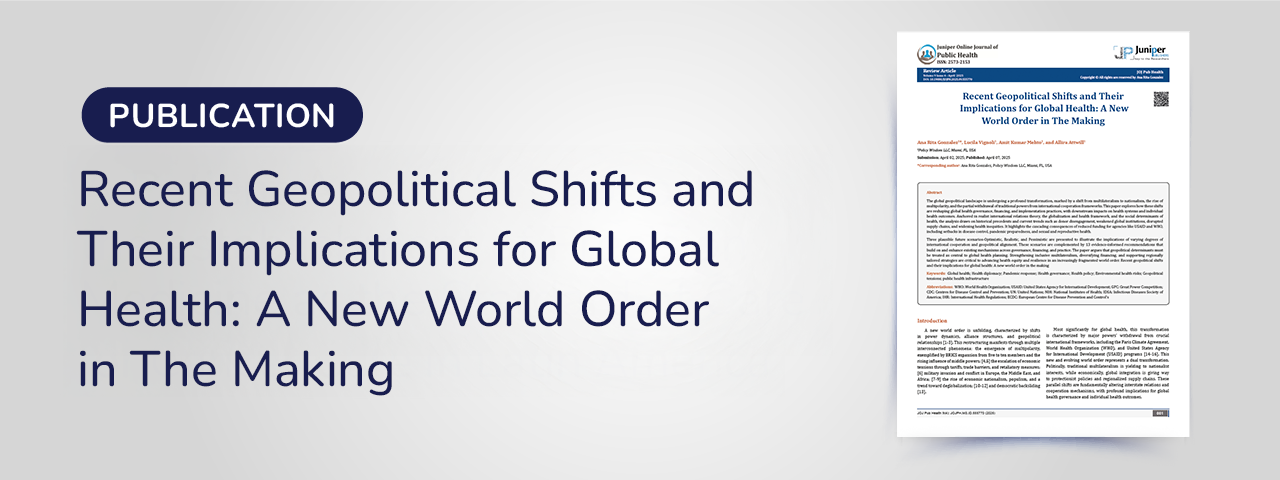
The global geopolitical landscape is undergoing a profound transformation, marked by a shift from multilateralism to nationalism, the rise of multipolarity, and the partial withdrawal of traditional powers from international cooperation frameworks. This paper explores how these shifts are reshaping global health governance, financing, and implementation practices, with downstream impacts on health systems and individual health outcomes. Anchored in realist international relations theory, the globalization and health framework, and the social determinants of health, the analysis draws on historical precedents and current trends such as donor disengagement, weakened global institutions, disrupted supply chains, and widening health inequities. It highlights the cascading consequences of reduced funding for agencies like USAID and the WHO, including setbacks in disease control, pandemic preparedness, and sexual and reproductive health.
Three plausible future scenarios—optimistic, realistic, and pessimistic—are presented to illustrate the implications of varying degrees of international cooperation and geopolitical alignment. These scenarios are complemented by 13 evidence-informed recommendations that build on and enhance existing mechanisms across governance, financing, and practice. The paper argues that geopolitical determinants must be treated as central to global health planning. Strengthening inclusive multilateralism, diversifying financing, and supporting regionally tailored strategies are critical to advancing health equity and resilience in an increasingly fragmented world order.
OUR CONTRiBUTiONS / RESOURCES AND PUBLiCATiONS / Recent Geopolitical Shifts and Their Implications for Global Health: A New World Order in The Making
August 20th, 2025
Recent Geopolitical Shifts and Their Implications for Global Health: A New World Order in The Making
Share this article:
Disclaimer:
Policy Wisdom blog posts reflect the views of the authors, drawing on prior research and experience in their areas of expertise. Policy Wisdom is a nonpartisan, independent organization and does not take institutional positions.