What can we learn from ten high-level policy executives from eight multinational pharmaceutical companies? Policy Wisdom, a virtual public health policy consultancy company, approached these top executives to measure and demonstrate the value and business impact of policy shaping.
Among other results, this study demonstrated that the investment in policy shaping can indeed have a desirable impact on the company’s business objectives and reputation, and benefit patients and society as well. A win-win combination from a business and corporate responsibility perspective! It also discusses nine topics relevant to policy shaping, including the impact of policy shaping throughout a product’s lifecycle, key contributing factors for engaging in policy shaping, timing, level of impact and return on investment (ROI), among other topics.
As a final bonus it provides access to a set of downloadable Policy Key Performance Indicators (PKPIs) designed to measure and demonstrate the impact of policy efforts pursued by staff and teams in policy, government and public affairs or market access departments.
Measuring and demonstrating how an effective policy-shaping strategy can positively impact and add value to the business is an ongoing challenge for the public health policy function.

“Policy is to access what vaccines are to public health, the most cost-effective and impactful intervention.”
Ana Rita González, President and CEO, Policy Wisdom, LLC
To examine the value placed on policy-shaping efforts as one of the strategic approaches to drive market access and business impact, Policy Wisdom conducted in-depth interviews with ten high-level policy executives from eight multinational pharmaceutical companies. Our research showed that although companies are increasingly recognizing the impact of policy-shaping efforts, consistent measures are still needed to reflect the unique value and broad impact of policy shaping and to demonstrate that investment in policy-shaping can have a desirable impact on the company’s business objectives and reputation, and benefit patients and society.
Our study covered the following topics:
- Making the case for investment in policy shaping
- Role and impact of policy shaping throughout the product lifecycle
- Measures to demonstrate the impact of policy shaping
- Key contributing factors for engaging in policy-shaping
- Value placed on policy shaping as a strategy to deliver market access and business impact
- Value, level of impact to the business and return on investment of regulatory vs health policies
- Preferred timing and level (global/regional/national) to implement policy-shaping activities
- Concepts of broad and sustainable access and their relation to policy shaping
- Company hesitation to invest in policy shaping
The value companies place on a particular business strategy or function is reflected in the level of investment and resources dedicated to it which, in turn, impacts the potential for success. Companies need to ‘walk the walk’ and fully demonstrate their commitment to effectively engage in policy shaping activities. Participants in our study felt that their respective companies strongly value policy shaping as a strategy to deliver market access and business impact, and that health policies have gained and continue to gain more importance over time.
| VALUE COMPANIES PLACE ON POLICY-SHAPING, AND TYPES OF POLICIES, AS A STRATEGY TO DELIVER MARKET ACCESS AND BUSINESS IMPACT |

When looking at the ROI by type of policy, we see that regulatory policies were reported to provide a slightly higher return than health policies, but both are considered to have significant impact to the business.
| VALUE COMPANIES PLACE ON POLICY-SHAPING, AND TYPES OF POLICIES, AS A STRATEGY TO DELIVER MARKET ACCESS AND BUSINESS IMPACT |


The value framework for policy shaping is rooted in the concept that policy shaping efforts can be organized into seven categories and plotted across the continuum from business to society. The efforts carried out within these categories influence each other and impact both the business and society in direct or indirect ways, depending on where they lie on the continuum.
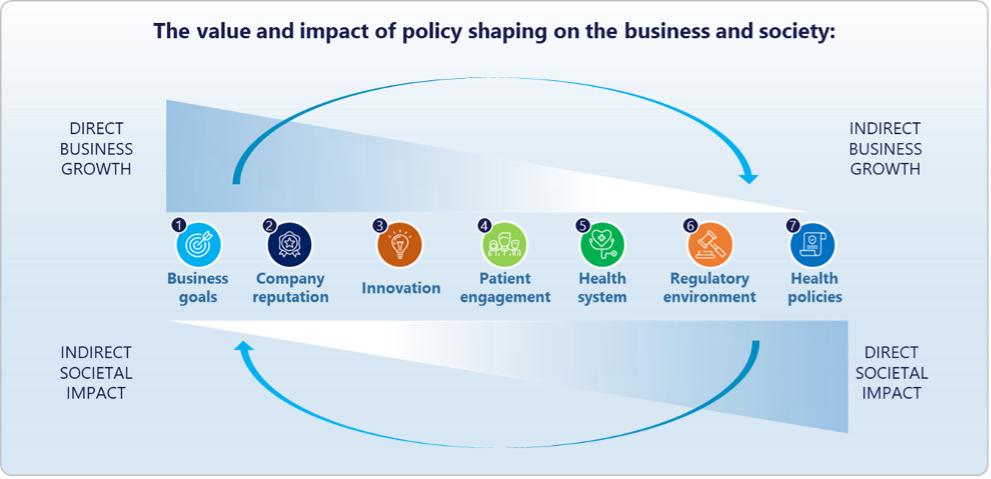

Utilizing the insights gathered, Policy Wisdom developed a Policy Value Framework and accompanying set of Policy Key Performance Indicators (PKPIs) designed to measure and demonstrate the impact of policy efforts pursued by staff and teams in policy, government affairs, public affairs, or access departments.
