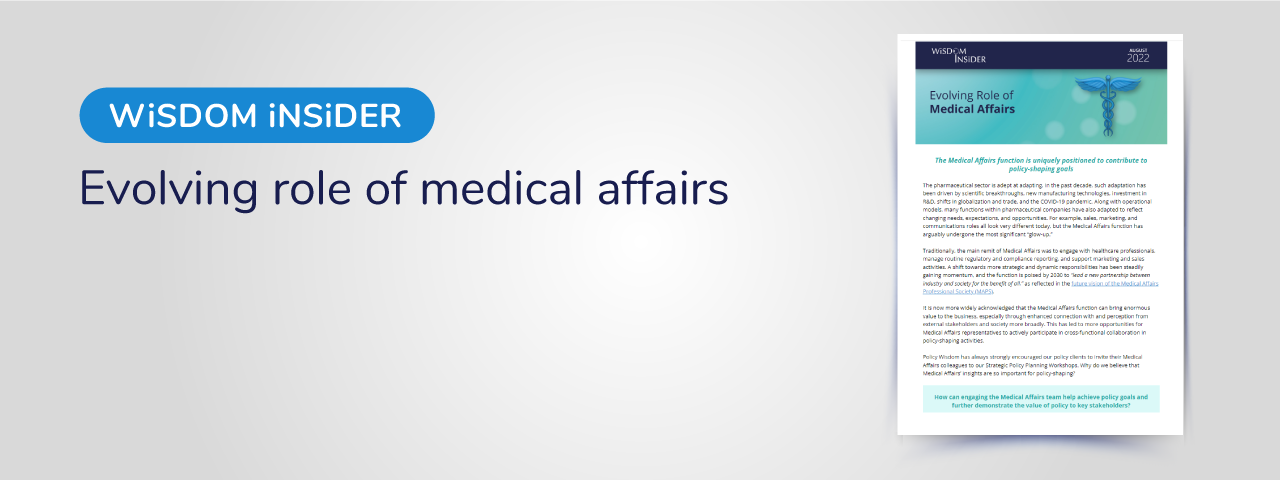
The Medical Affairs function is uniquely positioned to contribute to
policy-shaping goals
The pharmaceutical sector is adept at adapting. In the past decade, such adaptation has been driven by scientific breakthroughs, new manufacturing technologies, investment in R&D, shifts in globalization and trade, and the COVID-19 pandemic. Along with operational models, many functions within pharmaceutical companies have also adapted to reflect changing needs, expectations, and opportunities. For example, sales, marketing, and communications roles all look very different today, but the Medical Affairs function has arguably undergone the most significant “glow-up.”
Traditionally, the main remit of Medical Affairs was to engage with healthcare professionals, manage routine regulatory and compliance reporting, and support marketing and sales activities. A shift towards more strategic and dynamic responsibilities has been steadily gaining momentum, and the function is poised by 2030 to “lead a new partnership between industry and society for the benefit of all,” as reflected in the future vision of the Medical Affairs Professional Society (MAPS).
It is now more widely acknowledged that the Medical Affairs function can bring enormous value to the business, especially through enhanced connection with and perception from external stakeholders and society more broadly. This has led to more opportunities for Medical Affairs representatives to actively participate in cross-functional collaboration in policy-shaping activities.
Policy Wisdom has always strongly encouraged our policy clients to invite their Medical Affairs colleagues to our Strategic Policy Planning Workshops. Why do we believe that Medical Affairs’ insights are so important for policy-shaping?
How can engaging the Medical Affairs team help achieve policy goals and further demonstrate the value of policy to key stakeholders?
The scientific knowledge, technical expertise, and credibility that members of the Medical Affairs team bring to the table uniquely positions this function to engage and connect all policy-shaping stakeholders, internal and external. They “speak the language,” help us maintain our person-centered approach, and inherently remind everyone that at the heart of our discussion is a patient. Essentially, this helps us ensure that patient-centricity is woven into the essence of all policy-shaping activities.

The Medical Affairs Vision 2030
Medical Affairs will be a strategic leader at the center of clinical development and commercialization efforts, identifying and addressing unmet patient, payer, policymaker, and provider needs that advance clinical practice and improve patient outcomes.
— Medical Affairs Professional Society (MAPS)
How can Policy Wisdom support these efforts?

We help coalesce the efforts of Medical Affairs towards policy-shaping and help develop strategies suitable for Medical Affairs teams to implement.

We are passionate public health experts who specialize in policy and communication with policymakers. We help all sides listen better, respond more effectively, and act in the best interests of patients and public health.

We are results-oriented and can help you shift from wanting to be a better partner in public health to being a true partner in public health.