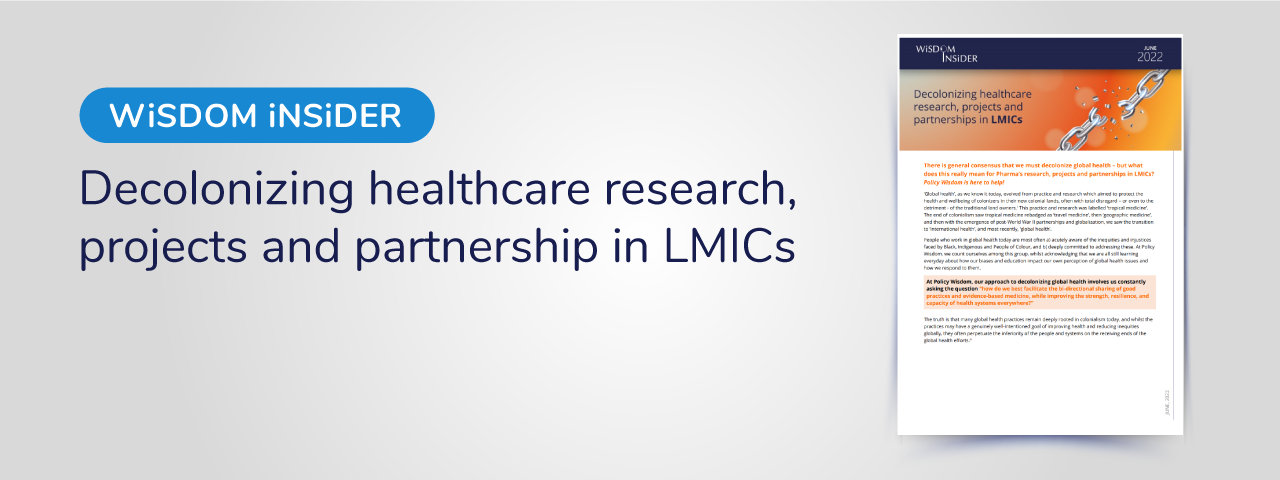
There is general consensus that we must decolonize global health – but what does this really mean for Pharma’s research, projects and partnerships in LMICs? Policy Wisdom is here to help!
People who work in global health today are most often a) acutely aware of the inequities and injustices faced by Black, Indigenous and People of Colour, and b) deeply committed to addressing these. At Policy Wisdom, we count ourselves among this group, whilst acknowledging that we are all still learning everyday about how our biases and education impact our own perception of global health issues and how we respond to them.
At Policy Wisdom, our approach to decolonizing global health involves us constantly asking the question:
“How do we best facilitate the bi-directional sharing of good practices and evidence-based medicine, while improving the strength, resilience, and capacity of health systems everywhere?”
The truth is that many global health practices remain deeply rooted in colonialism today, and whilst the practices may have a genuinely well-intentioned goal of improving health and reducing inequities globally, they often perpetuate the inferiority of the people and systems on the receiving ends of the global health efforts.2
‘Global health’, as we know it today, evolved from practice and research which aimed to protect the health and wellbeing of colonizers in their new colonial lands, often with total disregard – or even to the detriment – of the traditional land owners.1 This practice and research was labelled ‘tropical medicine’. The end of colonialism saw tropical medicine rebadged as ‘travel medicine’, then ‘geographic medicine’, and then with the emergence of post-World War II partnerships and globalization, we saw the transition to ‘international health’, and most recently, ‘global health’.
What do some of these neo-colonialist efforts look like in practice? A few examples include:

Extractive attitudes in the education of the healthcare workforce in HICs, especially in ‘Global Health Programs’. Students from HICs often spend a semester gaining valuable experience in LMIC healthcare settings. Here, they get to develop and practice their skills, but then depart without having upskilled local healthcare workers.

Global health agency headquarters and project leads being situated in HICs, whilst attempting to remotely solve public health problems in LMICs.

The assumption that LMICs do not have the technical expertise to solve their own problems.

Experts and scholars being sent to areas of extreme resource scarcity to initiate projects (and collect data and learnings), but do not adequately upskill locals to sustain the projects once they leave, and/or do not share the credit or benefits of that research with their hosts and collaborators.
How can the pharmaceutical industry ensure that their research, projects, and partnerships are proactively decolonizing healthcare?
At Policy Wisdom, we believe that we all have something to learn and something to teach, and therefore we must encourage bi-directional (North/South – or to use actively decolonizing language – South/North; West/East; LMIC/HIC) sharing of experiences and evidence in medicine and policy. Doing so will help to improve the strength, capacity, and resilience of health systems in both LMICs and HICs more broadly, whilst simultaneously working to eliminate health inequities, and the ‘benefactor/beneficiary’ mentality of many global health efforts.
Our commitment to addressing our own biases and perspectives motivated us to develop an ‘acid test’ list of nine questions, to help our clients immediately reflect on their past, present and future research, projects, and partnerships, and to highlight strategies that they can immediately implement to decolonize these.
The nine questions in our acid test form the first part of our methodology, which then leads to an analysis to help clients understand the “what, why, how, who, and when” of addressing any shortfalls.

We can very simply and quickly apply our ‘Decolonizing research, projects, and partnerships’ index to all of your current projects, and any that are on the horizon, to help you create a roadmap to proactively decolonize your efforts.
How can Policy Wisdom support these efforts?

Policy Wisdom is a certified ‘Minority Owned’ and led global health consultancy. Our team consists of public health experts who live in some of the world’s most notorious colonies (and also some of the most notorious colonizer countries), so we have an in-depth understanding of the nuances, complexities and different perspectives in this deeply-charged landscape. A non-exhaustive list includes Brazil, Puerto Rico, South Africa, India, Egypt, Nigeria, Australia, Canada, UK, Italy, and Belgium.

We are perfectly positioned as a neutral bridge to connect industry, government, civil society and patient groups to work together to decolonize research, projects, and partnerships. We help all sides to listen, hear and understand each other better, to respond more effectively, and act in the best interests of public health.

We are passionate public health experts who specialize in communications and policy. We can help you tell your story in a way that different stakeholders will understand and respect.

We are results-oriented and can help you shift from wanting to be a better partner in public health to being a true partner in public health.
References:
[1] Kim H, Novakovic U, Muntaner C, Hawkes MT. A critical assessment of the ideological underpinnings of current practice in global health and their historical origins. Glob Health Action. 2019;12(1):1651017.
[2] Kwete, X., Tang, K., Chen, L. et al. Decolonizing global health: what should be the target of this movement and where does it lead us?. glob health res policy 7, 3 (2022). https://doi.org/10.1186/s41256-022-00237-3